Biologist, Conservationist, & Portlander. My passion lives in Africa.

Sunday, March 23, 2014

A look back.

7:08 PM Posted by Unknown 2 comments
On my way back home to the USA, I reflected on my time in Kenya with the Elephants and Bees Project and Save The Elephants...

That was the craziest, most random, and challenging adventure I've ever had in my life. The majority of my time there, I had no idea what I was doing! Yet, here I am, almost four months later leaving behind the official Elephants and Bees Research Center. 


How strange is it that I now intimately know every employee at a hardware store in Voi, and that I have avoiding potholes in the dirt road to Mwakoma down to a science? I ate ugali and skuma wiki with my hands. I washed clothes with a scrub brush and bathed out of a bucket. I named elephants and wrangled with bees and tried my best to learn a bit of Swahili. I routinely shared tea with people who have completely different backgrounds and perspectives than I.


I helped build a research center that aims to reduce human-elephant conflict in the Tsavo ecosystem.


My experiences in Kenya will never be fully understood by folks back home, nor am I returning with a picture perfect album of African savannas full of the big five (although Tsavo was beautiful). My conservation work in the community was something that can never be taught in a classroom, and the lessons I learned along the way were quite a bit more difficult than I imagined. It takes a great deal of patience and understanding to live and work to conserve in a traditional village like Mwakoma, but the people are eager to learn, if you're willing to teach.

That is why I am so excited about this center. Along with attracting scientists from around the globe to use Sagalla as their base for research (I myself hope to return as a graduate student), it also functions as a local resource for environmental education. Further understanding of ecological and agricultural principles could make a huge difference in the food security in this area, as well as increase their beehive occupancies and honey production of our beehive fence farmers.


I temporarily leave the center with confidence. An intensive pollination study is just getting started at the same time that Lucy and Joseph conduct their playback research on the Tsavo elephants. My friends and co-interns are working out ways to better predict when hives are ready for harvest and change the attitudes communities have towards wildlife, and new inquiries for volunteers, students, and interns are beginning to come in. We've had visitors such as Iain Douglas-Hamilton and Fritz Vollrath, the Zoological Society of London and the Tsavo Trust, and I predict more will come. I see huge potential in this center, and I cannot wait to see how it progresses. 


Wednesday, March 12, 2014

A love note to Portland.

11:36 AM Posted by Unknown 2 comments
When I boarded the plane to leave Namibia summer after my sophomore year, I cried. Never before had I been to a place so wild. I thought - this is it. I've found where I am meant to be the rest of my life. I belong in Africa.

But as I sit here in Kenya, I find myself feeling somehow guilty for not having that same feeling of wanting to live here forever. I realize, of course, that some things were different on my Namibia trip. Life was certainly much easier, with the study abroad itinerary, camp helper, driver, and cook, but it was more than just the ease of living that filled my heart. I went rock climbing, quadbiking, and animal tracking. I got charged by elephants, swam with seals, and kayaked with dolphins. I braved waters that mix with Antarctic currents, and camped in the oldest desert on Earth. And, most importantly, I formed some of the best friendships of my life.

So when I came back to the suburbs of North Carolina, I felt lost and empty. At the time, I didn't know the U.S. could hold wild places that would give me the same sense of pride and fulfillment. I didn't know I could feel so complete in a civilization so tame. Now, I am proud to call Portland, OR my home, and a little scared by how much I miss it. For the first time in my life, I'm homesick. I look back through pictures and show everyone in Kenya and say, "That's my home!" It's where I can go skiing, and cliff jumping, and mountain climbing, and spelunking, and windsurfing, and critter searching. It's where I'm surrounded by people fighting to protect the beautiful places we still have in America. It's where I can save the world and enjoy it too. And, it's where I've made some wonderful friends and can enjoy a good [cold] beer with them.

There are some things I haven't missed: the need to post to Instagram the moment something cool is happening, the distraction of TV shows from being productive, and how ridiculously expensive fresh produce is.  But I still find myself longing for Mt. Hood and dream of the Gorge. It's not that I haven't enjoyed my time here. I am still ever passionate for all things Africa, and of course, the elephants. The opportunities that have come my way through this internship are endless, and the experience unforgettable. I plan on staying connected to Save The Elephants and all they do as much as I can. 

Conservation work in Africa will always hold a special, uniquely wild place in my heart, but Portland has helped me realize that I don't have to pitch a tent in a third world country to feel complete. And tweaking my dream a bit doesn't make me weak, either. It just means ... I want it all! I want to live in a city full of culture and life, minutes away from untouched wilderness, and have the option to travel all over the world - working to protect multiple things I care about, not just one species or group. If scuba diving with giant manta rays on vacation and coming face to face with a protective matriarch for work give me the same thrill and inspire the same actions, that's ok. It's only now, after working on an incredible project in Kenya for 3 months and being less than 2 weeks away from returning home that I realize that I can have it all.

So, thank you, PDX, for inspiring me to reach further and showing me how to live happier.


"... and I miss you; I'm going back home to the West coast..."

Sunday, March 2, 2014

Finally - we're in!

2:12 AM Posted by Unknown 1 comment

As I write this post I am sitting on a couch, in an office, with desks, electricity, shelves, and SPACE... That's right; we are officially moved in to the Elephants and Bees Research Center! It is so exciting to have a defined work space, a place to slump (looking at you, couch, my love) and to have our little 3m x 4m kitchen return to being just a kitchen.


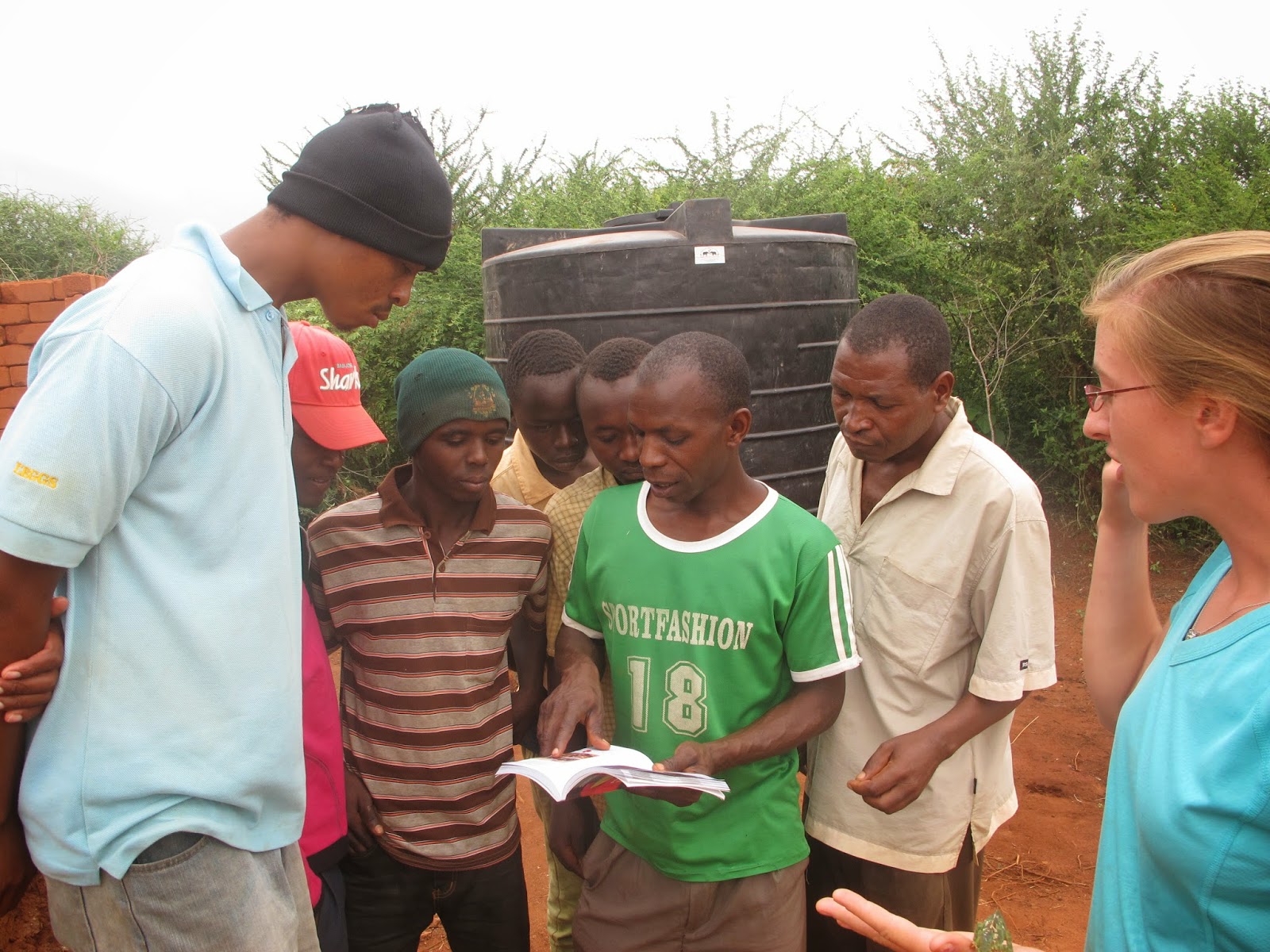
But more importantly than our own comfort, we can finally start using the center as it's meant to be used. We had our first official meeting last week with all of our beehive fence farmers. They are, after all, where the Elephants and Bees Project began, and they are why we have this research and community center now. We wanted to make sure they knew that this is a place to call their own - to have meetings, borrow equipment, learn about the environment, process honey, and do whatever else the center may be a host for.


We also discussed the purpose of our research at the center: to make their lives a bit easier. We will all learn together how to improve the beehive fences, get more bee occupations, produce more honey, and help each other out with any problems along the way. 

Lucy explaining our honey harvesting schedule

Tuesday, February 18, 2014

Precious Wabongo

4:50 AM Posted by Unknown No comments

Part of our many jobs as interns on the Elephants and Bees Project in Tsavo is to start laying the foundation for larger research questions about our beehive fences, such as, what makes bees happy? In other words, why are some hives or entire farms more occupied than others? So far, we haven't had too much time to dive into all the different components of these questions because we've poured all of our energy in simply repairing all the fences and getting them back up to code.


See the difference?


But despite the endless list of maintenance needs, one shamba has had undeniable success, and I only just found out why. 

Carley examining the bees in Wabongo's hive 8
Wabongo, a precious mzee (old man, respectufully) had 9 out of 11 hives occupied at the end of the rainy season. Having lost 2 occupations next to each other and finding dead bees all around, he called us one morning concerned, asking us to come check on things. A former Elephants and Bees colleague, Robert, and I turned up to speak with him, and he took us around his fence. 

Most of the farmer's know enough English to communicate to me the main needs and concerns of their fence, but Wabongo knows none. He talked as Robert translated, and for the first time, our visit was not rushed and I was able to get to know him and his attitudes towards the fence. He led us over to the recently vacated hive and explained that when the bees didn't come out to drink water for a couple days, he knew they were gone and checked inside. I asked how often he gives them water, to which he told Robert, "everyday". Well no wonder he's kept so many bees!

Shocked, I probed for more information. Wabongo walks his fenceline every morning, filling bottles and cans around the hives with water, and then going back around to add sugar. He covers the water with sticks to prevent the birds from interfering, and when the sources run dry on a hot day, he fills them again. 

Like other farmers, Lucy had given him sunflower seeds in the hope that the flowers would attract more bees. When the flowers stopped pollinating, he covered them with plastic to save the seeds from birds so he can plant more next season. He left some open because he still sees the bees going to them, he said. 

In previous years, he noticed that everyone's posts had trouble surviving the rainy season. So when others were beginning to plant crops, he first replaced his posts with stronger ones. Living alone and growing in age, he often hires a young man to cut these posts, but will not pay if he brings back posts that are too short!

He said the other beehive fence farmers were just interested in the honey, but he knows that his fence means food security, and without it, the elephants will come. "Lucy was kind enough to come and build this fence to protect my crops. It's why I make sure to take care of it. I know without taking care of it, the elephants will come," Robert translated to me. 

Wabongo talks to Robert about taking care of his fence.
I wanted to hug Wabongo, but I knew he would have been a bit confused by it.

As our center nears completion, our first official community meeting will involve gathering all the beehive farmers together to share stories, chat about what they've been doing on their shambas, and discuss the nyuki. I hope the others will learn from this wonderful mzee. 

Our crew, excited about finishing the ceiling.
As for the dead bees in Wabongo's hive, well, that's a research question for the scientists our new center will attract! Wabongo, clearly, is doing all he can to keep the nyuki around.


Friday, January 17, 2014

First raid of the season.

6:19 AM Posted by Unknown No comments
At around 8:00 on Friday, January 10, 2014, I sat down to the dinner table, starving and exhausted after a long day. As we dished out the servings of stir fry (a treat compared to our usual tomatoes, beans, and rice dish), Nzumu was helping Imran with one last task before he was headed home. As he worked, he casually said "There are elephants in the shambas."

RIGHT NOW?! Yes, right then.

We explained to him that we must go track them now, and we must know when they are around as immediately as possible for all of our research goals. He told us to meet him after we were through eating, and we will go find them.

I didn't even chew.

We jumped in the War Horse and began what turned into a wild goose chase. We went from shamba to shamba, slowly piecing together a story. The beating of drums and yelling in Swahili could be heard from every angle - each farmer working hard to try and protect their crops. At one point, after just confirming that the elephants were in a nearby thicket, I witnessed a brave woman walk off into the darkness alone, right into their path. She returned with assurance they were not headed her way.

We always seemed to be one step behind the elephants until Nzumu got a call from his wife, Josephine, telling him they were "climbing in his shamba and hitting the trees" at home. On his own turf, he was quickly able to pick up their trail, and concluded that they were headed for the water pan near Jennifer and Ambrose (two of our beehive fence farmers).

Back to the car we went, certain that we were finally on the right track. We parked and excitedly continued on foot towards the water when were interrupted by an army of safari ants. These fierce little insects cannot simply be smacked away, either. They must be pulled off of your body one by one. After having to literally strip down to shake them out of my pants and off of my skin, I finally arrived by the pan, still feeling a few sudden, pierce bites in my underwear.

After joining my team, I realized there were a few other people there, watching and waiting in an understood silence. Fires burning all around were set to keep Somali camel herders away, so we sat near them to shield the light from a possible ndovu nearby.

Not long after, a large, dark shadow appeared in the distance.

Elephants. Eight of them, maybe even ten. We could see their reflections in the water and watched them drink and blow bubbles. We heard the innocent sparring of two bulls off to the side, and the quiet rumbling of the happy herd. We were downwind and it was dark; they never suspected our presence. Every once in awhile I caught a glimpse of white. I was grateful to still be witnessing a healthy old matriarch with great big tusks.

After awhile, the herd moved off, and so did we. Returning to camp around midnight, I skipped the bucket bath and headed straight for bed. We would be up early the next day, tracking and measuring footprints, talking with farmers and assessing damage.


I tried hard to get a picture of the herd, but their identities remained concealed by the night. In a selfish way, I'm kind of glad I can keep that memory all to myself. First crop raid of the season.

Friday, January 10, 2014

Bees!

7:25 AM Posted by Unknown No comments
On the last day that Carley and I were on site by ourselves, I was about to crack. Balancing camp life (no, not glamping) with maintaining construction projects that produce an aesthetic and professional product was exhausting to say the least.

I had battled simple tasks meant to take 10 minutes that turned into hours for days. When I finally gave up at 6 pm that last evening, and walked away from a still incomplete shower, Nzumu said he was going to put a superbox onto one of Kakongo's hives and asked if we wanted to come.

I literally collapsed on the ground.

On one hand I was overwhelmed at the prospect of continuing to work with no one to start making dinner or even to wash the dishes from the day before for dinner. On the other, I wanted to go work with the bees and get something done for the actual project more than anything.

We grabbed our bee suits and off we went.


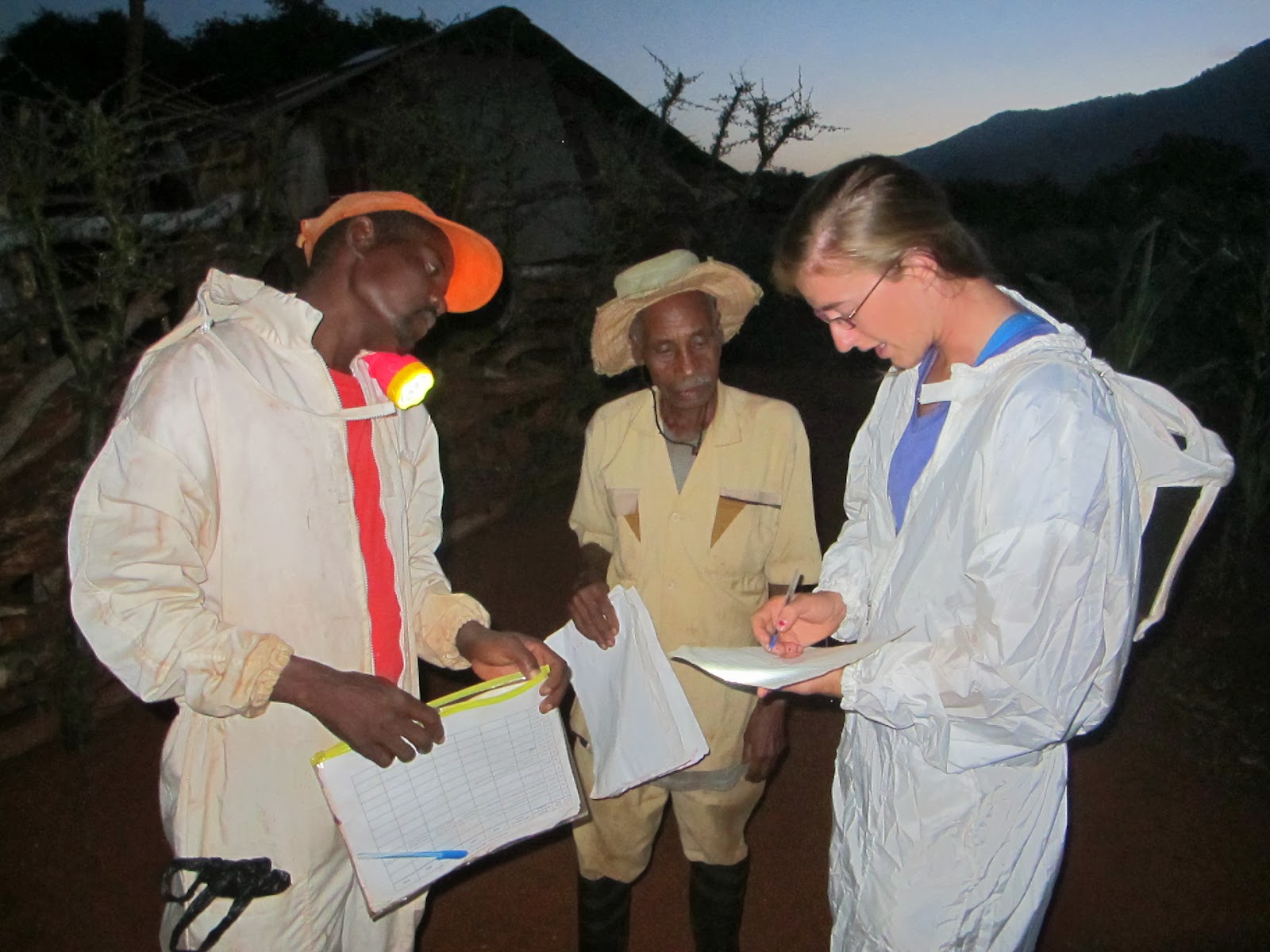
Putting a superbox onto a hive isn't nearly as extensive of a task as harvesting honey (which I got to do the following night), but it was a great intro into working with bees hands on. This was my first time in a bee suit, and I'll admit, I was quite intimidated. I had to constantly remind myself "it's ok, I'm safe in here. They can't sting you. They can't sting you. They can't sting you." 


Getting stung by a bee isn't that bad, but the thing about African honey bees is that when one stings you, it puts out a pheromone that tells all the other bees to sting you as well. Lucy has been through this unpleasant experience herself. After an uncountable number of stings from three different swarms, her entire torso seized up and she was rushed to the emergency room. So when I could feel bees bouncing off of me, and I watched them crawl around on my face mask, I was a bit nervous. Then I felt like a wimp when we found out later that Nzumu had been using plastic bags as gloves when he has gone out to work without Lucy around.

Carley, completely taken aback by this said, "Nzumu, don't the bees sting your hands?!"

He replied, "Yes, but I don't mind. They are my friends!"

I'm really glad I pushed myself to keep going that night.


A glimpse into the life of Dr. Lucy King

7:13 AM Posted by Unknown No comments
There is no such thing as a schedule in Kenya. You can make a plan for the next day and even have back-ups for your "what if" scenarios, but it's all useless.

Carley and I returned to Mwakoma after our Christmas break, excited to take on the challenge of project management in the absence of Lucy. On the day of arrival, we thought all we had to do was have a quick meeting with our fundi, Nzumu, to discuss the next two days' work, and surely we'd have camp set up well before dark. Of course, that's not what really happened. Our driver needed more money for his bus fare back to Nairobi which we didn't have to give. Chief Alex wanted to share mingi (many) stories. And silly us, we had to have known that we would need to buy more materials for the construction immediately before the stores closed through the rest of the weekend (nothing is open on Sundays)!  Duh.


Add in the typical "faff time" in Voi and it wasn't until 8:30 when we had finished setting up our tents that night. We had fried eggs and PB&Js for dinner.

I'll admit, I've held some grudges over the lack of time allotment for showers and food and those basic needs in the past, but after being the only on-site supervisor having to solve all the problems, including bandaging sliced fingers and running back to Voi for forgotten supplies, I will never be upset over a short day turned long again unless it was my fault. One day, Nzumu even had to come tell me (the one who gets angry when she's hungry) that it was time for lunch.

To get things done in Kenya, I've learned that I just have to roll with the punches and keep on keeping on. You may get a call at 8:00 at night saying a truck with our bricks that was supposed to arrive two days ago is on its way now, only to find out at 1 am that, in fact, they are not coming, again. But that's just how it goes sometimes.

On the bright side, the hard part is over. We are all moved into our amazing site, and official research on the elephants and bees project has begun!


Innovation

7:01 AM Posted by Unknown No comments
In the bush of Kenya, certain tools and materials can be in short supply. Whether it's out of the budget or simply doesn't exist in the local shops, many construction workers, farmers, landscapers, and families have to make do with what they have. This is certainly the case in Mwakoma, and the innovation I have witnessed from our work crew has been incredible.

Our main building, which will serve as an office, honey processing room, dorm, community center, library, meeting hall, and educational facility, was set into place thanks to string, sticks, and a right angle tool.


Our campsites are level and flat and beautiful thanks to, again, sticks, string, and a leveler.


Our perfect, cylindrical, cement toilets with proper seats were framed onto some plywood tied together with wire and sticks in a circle. These guys had never made a toilet like that before. Mostly, their long drop lous are topped with [scary] holes in the floor, but when we showed them a drawing of what we wanted they figured out a way!


Again and again I come to them with a problem and they come up with the most unusual solutions. Need a high tech metal saw to cut some mabati? No problem, just hammer a panga across it in a line. Wire cutters gone missing? Just smash it with a mallet!

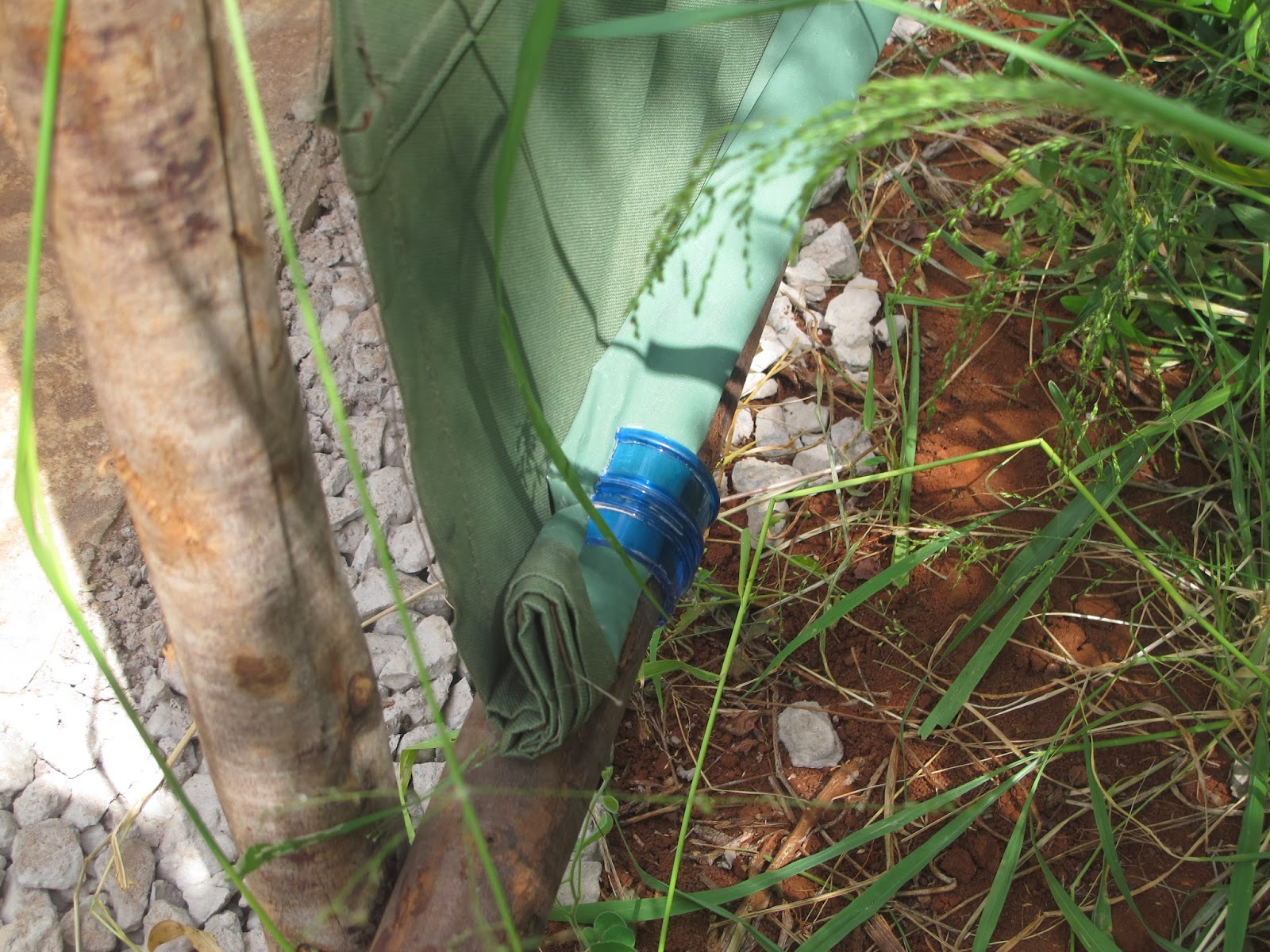
I like to think that I've learned a little from them as well. The shower has been the bane of my existence the past week. Convinced that it was a small enough job that we didn't need to pay men to do, Carley and I were determined to finish it on our own. First, we had no idea how to attach the gutters without the usual attachments and roof to nail it to. Instead, we hammered nails in to make a hole and tied them together with fence wire. Then, to protect our tarp from mold and dirt, we needed to roll it up a bit. I needed a clamp, but I knew I wouldn't find any in Voi. Solution? Repurposing plastic! We took the heads from water jugs and cut them in half to fit around the poles.


 According to Nzumu I am Tara: fundi of the shower! I'll take that!

Thursday, December 26, 2013

Sometimes we wash our hair in the rain.

4:27 AM Posted by Unknown No comments
Voi is a friendly little town just outside of Tsavo East National Park. It's our little bit of civilization that we escape to and get supplies from while camping in Mwakoma. The people are welcoming and not too pushy. If one store doesn't have what we need, managers kindly offer suggestions for where we can go to get it. A pitch fork, for example, was among these items in which we had to search multiple stores. I was the one who desired it so much; it's such a useful tool when dealing with brush piles filled with thorns! No one knew what I was talking about when I asked, so I drew a picture and they sent me on my way to a different store again and again. When Lucy pulled up with a pitch fork in hand the next day I squealed with joy... It's the little things.


Unfortunately, in all of Voi, there does not seem to be any tarp or tarp-like material that we desperately need for our dream shower. Situated just underneath a beautiful acacia, with views of the old boabab marking the corner of our plot and Sagalla mountain the distance, our shower will make bucket bathing a luxury.


While we have greatly appreciated the hospitality at Kileva Primary School, we are excited to create a space to unwind and get clean in the open air on our plot. Afterall, we can't always rely on a good storm to wash our hair in...


While in Nairobi, we will pick up some tarp and other materials to make this shower a reality. Enjoyable showers => Bathing every evening => Sleeping better => Brain power for further reducing human-elephant conflict => Happy farmers and happy elephants. And really, that's what it's all about.

Saturday, December 21, 2013

Pangas and Jembes

8:00 AM Posted by Unknown No comments

"Tara Tromper" is a name that was given to me by a co-conspirator of the field for my high work ethic and intense drive. I have nothing on the men and women of Tsavo. In fact, I've never felt so useless in my entire life.


On Tuesday, December 10, Dr. Lucy King and the team met with the Mwakoma village leaders to discuss plans for the Elephants and Bees Project community, education, and research center. With a Memorandum Of Understanding and smiles all around, I watched two worlds collide and a suitable plan unfold that benefits both parties. 


On Thursday, the entire community gathered for "Ngula" which is a Taito word for coming together and working for a common purpose. In half a day, with pangas (machetes) and jembes (hoes) alone, they cleared enough of our plot to hold our community center, camp sites, kitchen, toilet, storage shed, driveway and parking lot. I tried to jump in wherever I could, swinging my unsharpened panga, hopelessly trying to mimic their movements but recoiled after every pierce of thorns. Mostly, I was just in the way, so I was happy to stand back and document it all instead. It also just happened to be Kenya's 50th anniversary of independence. We celebrated our hard work and Kenya's birthday with rice and beans, and of course, tea.


The next day, building began. Our storage shed was up in a flash; two campsites and a 15ft deep hole for our toilet followed soon after. The Mwakoma ladies hauled in sand on their heads, earning money by the bucket that will soon filter through the village. The other interns and I found where we could be useful and slowly attempted to earn a better reputation for the work ethic of Mzungus. By Thursday the 19th we had 20 men hastily passing kurais full of cement and agrigate (it's called gravel, silly Europeans) to fill in the foundation for our center while we served them tea and snacks out of our new kitchen. Lucy sat and wondered how this all happened so fluidly - her plans predicted a foundation to be set no earlier than three weeks. 


We leave the Tsavo area tomorrow for a Christmas in Nairobi and New Years on the coast. With a break from construction and better access to internet, many more updates will follow. I, for one, am looking forward to a real shower and an oven to bake a cobbler with all these amazingly cheap fruits around me. 

Monday, December 9, 2013

So... I'm in Kenya.

10:51 AM Posted by Unknown No comments

It's been awhile, and for that I do apologize. Let me catch you all up.

On October 12 I went to the WCN Conservation Expo in San Francisco that I was so excited about in my previous post.

I met THE Jane Goodall. 


And Dr. Iain Douglas-Hamilton


Oh and they're best buds, by the way...


I told Iain that one of my best friends, Carley, was interning at Save The Elephants and that I hoped to follow her some day when I had the funds. It was a fantastically inspiring day.


A couple weeks later, having come down from my high on life from the conference, I went to Hawaii with some friends...


And I get a frantic call, post-luau, from Carley about an exciting project developing within Dr. Lucy King's elephants and bees project and that I quickly needed to apply to be a part of it. I had no time to waste, so as soon as I got home I sent her a letter, had an interview the following evening, and was booking a plane ticket for Nairobi in the next week. 

So, here I am, in Kenya! 

Here's the breakdown: 

Lucy builds beehive fences around farms to protect them from elephant crop raids because elephants are afraid of bees. She's been working outside of Tsavo National Park for awhile, and after gaining support in the community, backing from STE, and wonderful grants and donations, she is launching a new human-elephant conflict research and community center (title still to be decided on). And we (Lucy and her new team of interns) are starting from scratch. Tomorrow, we head out to Tsavo, where we will study our donated acre of land, and get to work clearing a plot and buying supplies. I cannot even begin to express my excitement for being here, and to be a part of this massive project that will lead to such positive impacts for people and elephants!

This morning I got to meet the STE team at their Monday morning meetings. As I sat there, surrounded by all these passionate, brilliant people, I thought of how lucky I am to be achieving my dreams. Unfortunately, Iain could not be at the meeting. I so wanted to say hello again.


Pssst... Internet access will be questionable throughout my stay here, but stay tuned for details about Save The Elephants, Lucy's amazing work, news from Kenya, and my experiences here!!!


Sunday, September 22, 2013

The little things.

11:32 AM Posted by Unknown No comments


Okay, okay, all jokes aside. In all seriousness I have to admit that the animals that I read about as a kid, that I fell in love with at the zoos, and formed a relationship with on my first big adventure in Namibia do exist in a complex, beautiful, and often overwhelming part of the world, and lately, I've been feeling pretty discouraged about their future in Africa.

In order to preserve and protect the creatures I care so deeply for, I've been trying to learn everything I can about African nations: their histories, their current status, their needs, their cultures. The more I learn about Africa, the more I discover about the entire world, and I have to say, I don't like what I'm finding. I am not naive enough to think that I could even begin to "fix" the problems that the people of Africa and the world's most powerful politicians have not been able to solve, but how can I even help to facilitate positive change when the magnitude of issues I will come up against are so great and complex?

It's easy to think this way. That's exactly what Paul Loeb discussed in an interview with Idealist
Cynicism is the corrosive acid that says, “Why bother? Nothing that I’m going to do will matter.” Cynicism mocks the idealist. It’s different from saying, “I disagree with you about tax policy.” The cynic is the person who says that this work in its entirety is futile. 
Imagine if Nelson Mandela or Susan B. Anthony thought this way! So how do we avoid cynicism? How do we avoid drowning in the evils of international politics or the challenges of global climate change? 


We take it one day at a time. 

Paul calls on nonprofit organizations to remind their staff that their work is worth something and appreciated, and his advice for individuals? When you've lost a political, social, or environmental battle, simply go back to something that nourishes your spirit and recharge.


I've been volunteering for the Kasese Wildlife Conservation and Awareness Organization for awhile now. I haven't been doing anything major, just updating their Facebook and Twitter accounts, trying to raise awareness about this organization's amazing work in Uganda. In the meantime, learning about the conflicts in the DRC, Uganda, and Rwanda is enough to make my head spin. Well, Asaba called me last week to tell me a little story... 

He told me about a good friend of KWCAO that raises money for them almost every year. The first year he raised $2,600. The third year, he promised friends and family to dye his hair in order to raise money - $4,004 worth. The fourth year he had no campaign, but set out again on his fundraiser. He asked his usual donors and new friends to give whatever they could, whether it's 10 dollars or 100. Here and there he collected, and he handed Asaba a $5,050 check this year. Asaba couldn't believe it. $5,050 can go so far in Uganda! They got to talking, and Mike told him a story of one of his donors that wrote him a check for $100, but then Mike told this donor about a post he had seen on Facebook about KWCAO's office manager. After the donor heard about this young woman, he wrote a new check, changing his donation. So even though I consider my contribution to this group to be small, Asaba excitedly told me that it's because of my efforts that this donation went from 100 to 500 dollars. And it's people like Mike, who go the extra distance, that help this organization make a big difference in Uganda and for its wildlife. 

I'm thankful for the reminder that people like Asaba and Mike provide: that every little bit really does make a difference. It's important to be informed about the world, but don't let that information stop you from acting.


Monday, May 6, 2013

Professionals in African Wildlife Conservation Reception - Lucky Me!

9:43 PM Posted by Unknown 4 comments

Last Thursday, the World Affairs Council of Oregon and Oregon Wild hosted 13 wildlife conservation professionals from 9 different countries in Africa who were touring America with the International Visitor Leadership Program. The purpose of their visit was to strengthen ties with organizations and supporters in America to unite against poaching and illegal wildlife trade. 

At first I looked around for Namibia's representative, knowing I would have plenty to discuss with him. Unfortunately, I discovered he was unable to attend this event. I wasn't sure where to begin, not having as much of a connection with the other countries' representatives. I decided to sit down and just observe for a bit, perhaps take notes on how to best introduce myself, when the woman next to me said hello.

We chatted for awhile about which organizations we were here with. She asked if I had volunteered with Oregon Wild, seeing my "Keep Oregon Wild" sticker in hand. I said no, but I'm a big supporter of their work. She replied that she was the Conservation Director's wife and asked if I would like to meet him. 

Perfect! A place to start (not to mention Oregon Wild just happened to open up a position that has my name all over it, fingers crossed). After talking with him about how he got involved with this event, what all Oregon Wild does, and how much respect he has for my boss at the Center for Biological Diversity (boosting my confidence in my upcoming application), it was time to get a bite to eat.

Choosing a random seat next to Mr. Ramalefo of Botswana, we discussed predator-livestock conflict over sweet potatoes and chicken. That's my kind of meal. Finally, it was time to formally introduce everyone and hear brief presentations.

Steve Pedery began with Oregon Wild, pointing out that the problems in conservation we face here are not too different than those in Africa. After bringing back wolves from the brink of extinction, we are still in a constant fight with ranchers and hunters to keep them protected.

Then came the first African speech by a national park official from Zimbabwe. He talked about their parks, their rhino, pangolin, and painted dog populations, and their partnerships between the private and public sectors. Then he mentioned their struggles.
People are looking after the rhino, and not after the people trying to protect them. These men are not military trained, but war-like combat is what they face. They have limited resources, little time with their families, and no incentive to keep at it. They need to feel like they've achieved something."

I, in a super selfish, privileged American kind of way, can relate to that feeling. I wanted to tell him about the Thin Green Line team. There are people who care, people who hear you.

Next up, Zambia. He echoed the plea for the rangers and took it a step further. What many people don't know about these armed poachers is who they are funded by, and who they are funding. Many times, these activities are feeding terrorist organizations. Why else would they risk their own lives for a rhino horn? And of course, there is always the issue of habitat degradation. As resources are used, human wildlife conflict grows.

The third speech was given by my dinner buddy, and while he seemed a little quiet person to person, he provided a powerful ending to the presentation.

"I am not here to tell you the sad story of Africa. I am here to tell you about the successes we've had, not only as Botswana, but as people."

Immediately, I'm on the edge of my seat. He spoke about legislation coming into agreement with science more often, and the Transfrontier Conservation Area which was agreed upon and is managed by five different countries. There are wildlife management courses in college, and an academy in Botswana for law enforcement where they discuss wildlife crime.

Though we have successes, there are still challenges."

We need to figure out a way to actually use the bit of training our wildlife rangers have received in the field.

We need to include our communities in our efforts to preserve wildlife so they are not enticed by money to support poaching.

We need to teach children about wildlife management, (at this point I wanted to stand up and cheer, but I sat there silently scribbling down every word, beaming about my involvement with KWCAO who is doing just that) and take them to our national parks, most of which they have never been to, even though they live so close.

We need to get media on our side and ask them to stop advertising poaching. By repeatedly saying over and over how much a horn is worth, and what poachers get from a single rhino, and how many elephants are killed a day, we do nothing but add fuel to the fire.
Law enforcement cannot do it all."


With a little bit of time left in the evening and my head bustling with questions, I spoke with as many of the men as I could. They were all so friendly, eager to make connections and hoping in general that the people they meet on this trip around America will be inspired to act. While all I can do for now is blog, I sincerely hope they achieved what they came here for: international cooperation to fight illegal wildlife trade.

They all asked when I was going to come visit them in Uganda, Tanzania, Zimbabwe, Botswana...

"Soon." I said. "Very soon."